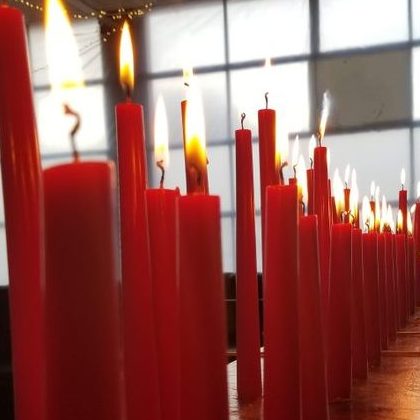
We parked the car about a block and a half from the local Catholic church’s building. It was a leafy neighborhood in the South Jersey suburbs near my home. We had never been to a meeting with this church before. It was the peak, or the nadir, of a long season of dislocation we were experiencing, a few months after I had left my work as a pastor. My departure was not pleasant, nor was the time leading up to it. But it was Pentecost and I just had to “go to church.”
As my family approached the dirty blond bricked building together, buds blooming all around us in the trees, bulbs all opening beautifully in the neatly tended beds along the sidewalk, I noticed a preponderance of red in the garb of the other gathering worshippers. There was a man with a red tie, and there was a woman with a red frock, and that kid’s shirt was more pink than red, but it would do. I found out later that the priest had put it in the bulletin that everyone should wear red to celebrate Pentecost, but I had joined in this communal ritual, it must have been, by the power of the Holy Spirit. I put on my red and white plaid shirt that morning as if I had received Father Yvans’ memo. It was Pentecost and red was the right choice. As I walked into the sanctuary it felt so good to belong, because during that season of dislocation, I was so needy for that feeling of belonging. It was like the tendrils of my roots suddenly gripped tightly around something deep below the ground.
I was amazed by the power I experienced in this Pentecost wardrobe ritual. How could something so simple as wearing the same color shirt make these people my family?
Well, it was Jesus who made us family. We read in Hebrews, “So now Jesus and the ones he makes holy have the same Father. That is why Jesus is not ashamed to call them his brothers and sisters.” (Hebrews 2:11) But it was the shirt that made me feel it! It was ritual that made us kin.
Researchers in the cognitive science of religion, critical thinking, and emotional intelligence like Laird Edmond of Northwestern College have been working on uncovering data which describes my experience through a scientific lens. I heard an interview with Laird Edmond on Dan Koch’s “You Have Permission” podcast (Episode #191).
Laird was giving me new grounds to appreciate the rituals I keep. I’m paraphrasing my own recollection of the conversation, not quoting him. Human brains are not evolved for the modern ways we ask questions about identity. “Who am I?” is a very modern question, especially on an evolutionary scale. Our hunter-gatherer ancestors knew who they were by whom they were with. Group Identification was identity. It was key and needed to be almost automatic. Was this person a friend or an enemy? Was this person a potential mate or a near relative? Our brains are developed to know who we are by recognizing those who look, act and talk like us. You might say it is unnatural to make these decisions solo. We are communal creatures, at very least in our brains. Too little time has passed for us to be fundamentally different. Cognitively, we are still basically the same as our hunter-gatherer ancestors.
We are collectively aware of many very concrete modes of group identification that still exist today. Think of tattoos in the South Pacific, or distinctive styles of dress in remote tribes in Africa, but also think of circumcision among the Ancient Hebrews and the majority of males born in the United States in 2006 (the most recent year I could easily find). I’m also thinking of when I was a teenager and how important the radio station I listened to was, or how important it was that I looked like I could skateboard even if I never took the time to get really good at it. The teenage years are so primal! Maybe we are most human when we literally wear our hearts on our sleeves (even if those hearts are not yet fully formed).
In the muddy mess of identity formation as it is today, we would do well to look to ritual as a means of knowing who we are, where we belong, and even what our purpose is. At one point in European history, Church ritual defined everything about communal life. Our primordial need manifested itself in how the Church was organized. There were regular opportunities to participate in a ceremony of belonging. I imagine burnout and suicide were much rarer (but I haven’t done the research). Without regular experiences of a “we” of which we can say is “us” the human person is in trouble.
Today this need is mostly colonized by multinational corporations who have mastered the manufacture of desire. Marketers understand humanity better than many pastors, certainly better than most everyday consumers. Our need for belonging is manipulated and twisted, but it is still very much there. I felt it when I walked up to the red clad congregation.
God obviously did not need me to wear red on Pentecost. Of course, some people don’t even own a red shirt or have access to one if they wanted it. But I have a red shirt, and I needed to wear it. Ritual makes us kin because it makes one people out of many. We do something together that we all need. We are divided by so many more lines than the major ones like race and class. The gulf between each of us sometimes seems immense. The powers that be oppress and expand their divisive influence, and we, the Church, must respond. Today, I’m praying that some ritual shoots your roots into the soil of belonging in a way that is so easy to see and feel. May you be made one. May we be kin.
 Today, if you hear his voice