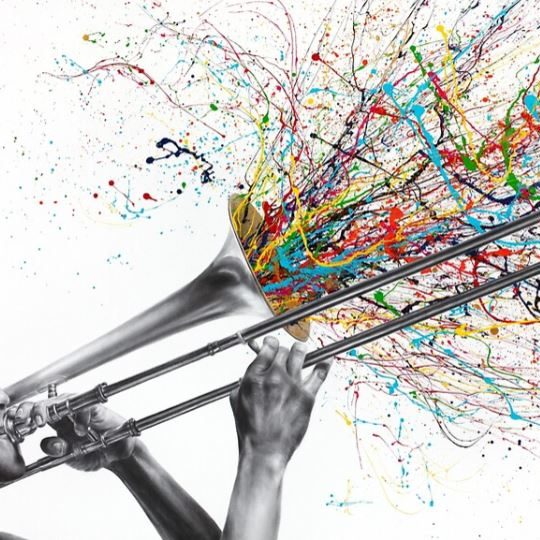
I have dreams of putting a beat to most of the Bible. There’s a lot of poetry in there. One time a group I was part of spent a couple of months reading through the letter we call First John. That letter is a spoken-word Jazz piece if you ask me. Repetition, returning themes, deep grooves… It’s begging for a bass line!
The group talked a lot about how our composition would sound but we never recorded anything. We did, however, read it in its entirety outside in the park by flashlight to cap off our study, because it’s all about light in the darkness. That is a wonderful memory of embodying the Bible.
“How do I read the Bible?” I wish that my answer was, “With snare, high-hat and kick drum.” But alas, I am not a drummer. Even when I can’t realize my vision myself, it feels good to line up with a spiritual corps. The rhythm is there and I’m not the only one to see it or hear it. James Weldon Johnson is an inspiration of mine in this regard. He was an acclaimed poet and writer of the Harlem Renaissance (1920s). He wrote the words to the Black National Anthem (Lift every Voice and Sing) and he was a diplomat to Venezuela and Nicaragua on behalf of the US government. I want to share this poetic version of Genesis 1 and 2 called, fittingly, “The Creation” from a collection of what Johnson called God’s Trombones: 7 Negro Sermons in Verse.
This recording from the 1990s is a reading by William Warfield who was a Bass Baritone singer and Actor who had his hay-day in the 1950s. Listen to the word pictures and rhythms that these two artists, together give us. You might connect to the Original Artist, as you listen for four minutes.
That’s good! Do you think they got it? I do.
“How do I read the Bible?” The Bible is alive with William Warfield’s warbling voice. The Bible is alive with James Wheldon Johnson’s imagination. The Bible is alive with every kind of rhythm and creativity. The point of the Creation narrative in Genesis is joining in. I think God is saying about James Weldon Johnson and William Warfield right now, “That’s good!”
Some people might say James Weldon Johnson was adding things to the text that didn’t belong there. Others might say that the idea that God could be lonely is a violation of some “ity”, “ence” or “ism” about God. But I don’t read the Bible that way. Why wouldn’t God be lonely? And how much does it matter if we’re not exactly right about that?
How do I read the Bible? Didn’t James Wheldon Johnson get the point? Can’t you feel it when William Warfield speaks his words? I think that’s what matters, or at least where we ought to start when we read the Bible. The best questions are “Can you feel it?” “Is it in your bones?” What does it make you want to do?” “How can you join in?”
How do I read the Bible? I must begin with what I know and from where I am. Many have said that to do so is to follow ourselves — our emotions, our conditioning, our preconceived notions, our prejudices. I agree there is some danger in that. The Bible is very adaptable, as all words are. The Bible has been used to justify all kinds of idiosyncrasies, preferences, and down-right evils. However, the project of interpreting the Bible in academia for the past few centuries; which has been dominated by white, straight men from Europe and the United States; has most often served the interests of similarly located individuals in society while claiming to achieve an actually very illusive objectivity. Otherness erased, it has been easier to claim simplicity in a book that was, in fact, designed to enfold the multitudinous complexity of Creation, what it was at the beginning, and all the ways it would become — all of the potential energy stored up in every living thing, especially every human person. And so, it is very important to begin with what we know and where we come from, especially for white, straight men from the United States like me. To reduce the Bible to a set of principles, is to make Everything into a few tiny things that can fit in your pocket. Many terrible things have been done out of those pockets.
But I say more. Beyond the selfish manipulation of those in power, the reductionistic, sterile, cerebral project has missed the main point of the Bible for everyone. The desire to protect the “ities”, “ences” and “isms” of God have un-embodied a book that was all about God making a world and a people with which to dwell. Imagining God as lonely “down in a cypress swamp” is living with God as who you are and where you are. You might not know anything about a cypress swamp, but how would you imagine the nothingness before God said, “Let there be light”? James Wheldon Johnson models the permission we have to see and feel our way into the Bible. How do I read the Bible? with my own eyes looking at my own life.
The expectation that God is alive and still God-breathing this ancient book into existence is essential. In the same way that the Bible is God-breathed, we are God-breathed, no? How do I read the Bible? As a God-breathed body, bounded by an abundance of life and possibility that God gave and keeps giving.
How do I read the Bible? With my imagination. My spiritual grandfather, George MacDonald, makes the case I am trying to make in a very Victorian way in this “Unspoken Sermon.” MacDonald makes a still novel argument for the authority we have to engage contemporary issues with our imaginations and our hope. We can go beyond the letter of the written word. Recognizing the intentionally incomplete nature of the Bible and relying on the completed Jesus to whom the Bible points us, we, in fact, must go beyond the letter of the written word in order to get any of the Living Word’s living sap into our leaves. Not only does this approach to the Bible open up the possibilities of real engagement with God for every individual, but it also opens up our communal discernment process to consider how we might respond to new and unfolding circumstances encountered by our communities.
During Pride Month, accepting the welcome Jesus offers us through this open door of possibility would be so very good for all to do. How refreshing it would be to transform the tired conversations that are ripping the Church at-large apart by entering into the realm of possibility Jesus offers us? What if we went into the wide-open landscape of here and now? What if we crossed the threshold of the even-more-than-we-can-ask-or-imagine-ness of life in Christ? MacDonald’s challenge to the rigid orthodoxy of his context is still so very relevant because the “dull disciple” of his sermon has managed to stay in control of the conversation. George MacDonald’s legacy whithers in relative obscurity while other, less expansive thinkers rose to prominence. The Western Christian Imagination has closed that imaginative door in favor of the “ities”, “ences” and “isms”. Many too many have accepted the resulting arm’s length (and often universe’s length) distance from Jesus by accepting the Bible as intermediary between the disciple and the Living Word. How do I read the Bible? To summarize succinctly: God gives so much more room than we allow ourselves. I wish we all would take the offer. The mercy of Jesus will keep us safe.
But you, dear friends, must build each other up in your most holy faith, pray in the power of the Holy Spirit, and await the mercy of our Lord Jesus Christ, who will bring you eternal life. In this way, you will keep yourselves safe in God’s love. — Jude 20-23
How do I read the Bible? By joining in. So, I better do it before I’m done. Here’s a bit of dreaming with the end of the Book of Job. Throughout most of the Book of Job the title character is arguing with God and with his friends about the nature of suffering and the justice of his cause. Job believes he has done nothing wrong, and he wants to know why so many bad things are happening to him. His friends insist that he must have done something wrong- that there is some calculus to suffering. Finally, when God shows up at the end of the book and responds to Job’s complaint there aren’t too many direct answers. God simply delights in Creation. God expounds on the loveliness of living things, the immensity of land and sea, the presence of God’s love in all things.
Here’s one of my favorite parts:
“The wings of the ostrich flap joyfully,
though they cannot compare
with the wings and feathers of the stork.
She lays her eggs on the ground
and lets them warm in the sand,
unmindful that a foot may crush them,
that some wild animal may trample them.
She treats her young harshly, as if they were not hers;
she cares not that her labor was in vain,
for God did not endow her with wisdom
or give her a share of good sense.
Yet when she spreads her feathers to run,
she laughs at horse and rider.“
— Job 39:13-18
Silly Ostriches! But oh my! How they can run! God is reminding us that we are part of it all, even in our own silliness. Job might be expecting an “ity”, “ence” or “ism”– a neat glass of water poured from some divine pitcher. Instead, he gets a muddy roar of love and wonder. Job’s friends’ pristine notions of how life is supposed to work are overwhelmed. They are all caught up in something much bigger than they can understand. God’s answer is, “Celebrate with me how amazing ostriches are! Celebrate with me how anything exists at all!”
And now, the joining in! Here are a few internet animal facts I have artfully arranged for you in honor of God in Job 39.
Dolphins have names for each other,
Clicks and squeaks that can mean something like “You” and “Love.”
Sea otters hold hands while they sleep;
Their grip making their hands look even more like ours.
Gentoo penguins propose with rocks
Presenting a pebble, they hope to make a nest.
And butterflies taste with their feet,
Probing with petal steps then dipping heads to drink.
Turritopsis dohrnii can live
Forever; infinite renewal does happen.
Squirrels may plant ten thousand trees
Simply by forgetting where they buried their nuts.
Praise God! We’re part of that! Every human being is probably even more fascinating than those silly squirrels. Though our little brothers are attractive in their relative simplicity, it’s our complexity that makes us so worthy of discovery.
Much of our lives are shaded by rooves and conditioned by machines. It takes effort to unplug and connect to God and this symphony of Creation, but we can’t miss out on this party. It is a great source of joy, even if you don’t consider yourself an outdoorsy type there are ways to tune in to what God is doing and laugh with ostriches. We need to say WOW. We are made to be wowed and to relate to the One who wows us. We are made to relate to our Creator, yes the Creator of the universe and maybe even the multiverse. Jesus, who was there at the original party, came to be with us inside the Creation he witnessed, and in which he participated, spiking the flood with himself and strengthening the drink of our existence, binding us together with God in an even more immediate way than before, and cutting a channel into an ocean of grace that we can float in forever. How do I read the Bible? With Him in whom I live and move and have my being, and in all the possibilities presented or pretended
… and with a beat.
 Today, if you hear his voice