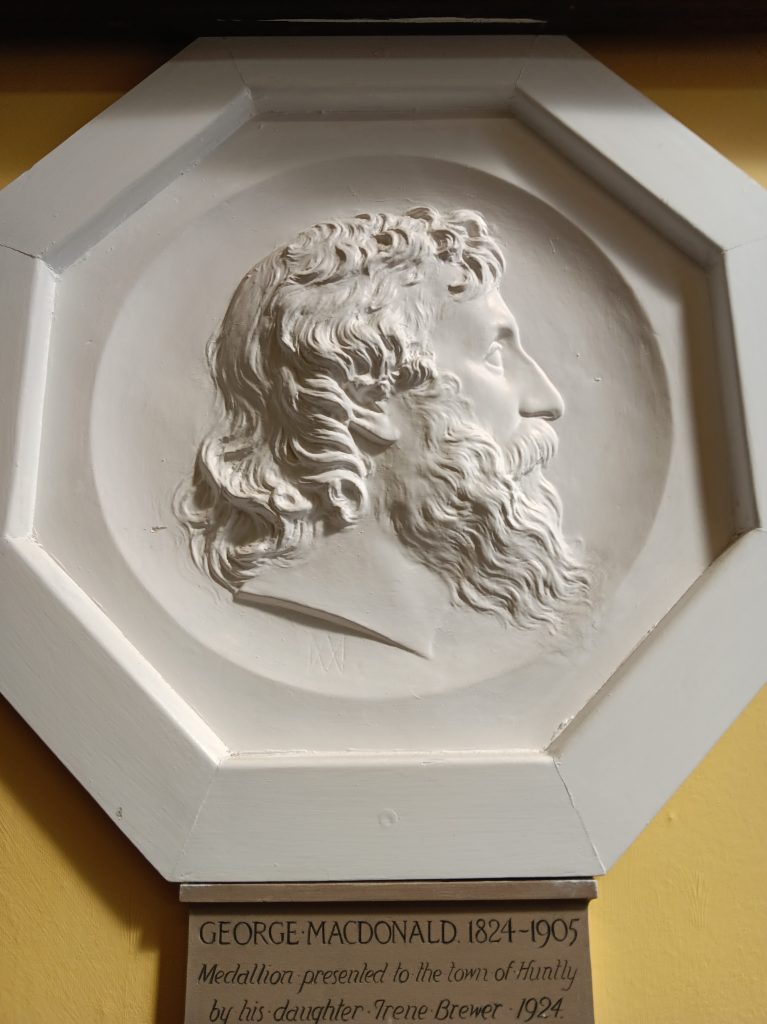
On his death day, September 18th.
When all is lost our love glows in the dark,
And we’ll see so much better when we dare
Obey and keep our commentary spare.
Why say, “I’m a worm!” you who are a lark?
Up high he flew and called sweetly from there
Where eyes won’t reach but our hearts are aware,
Grandfather MacDonald, my rose-fire’s spark!
On his own Malta he shook off the snakes
Of those who would speak of the Bonny Man
That had no share in the Father o’ lichts,
But his share was bright to show their mistakes,
And sharing across a century’s span.
He brightens the lights of love in my nights.
You can listen to me read it here https://on.soundcloud.com/A5X1ECTxkL7jt3ypmq
Some allusions documented here:
Love glows in the dark
The moment she touched his arm, they saw an arch of blackness before them. They had walked straight to a door—not a very inviting one, for it opened upon an utterly dark passage. Where there was only one door, however, there was no difficulty about choosing. Richard walked straight through it; and from the greater fear of being left behind, Alice faced the lesser fear of going on. In a moment they were in total darkness. Alice clung to Richard’s arm, and murmured, almost against her will, “Dear Richard!” It was strange that fear should speak like love; but it was in Fairyland. It was strange, too, that as soon as she spoke thus, Richard should fall in love with her all at once. But what was more curious still was, that, at the same moment, Richard saw her face. In spite of her fear, which had made her pale, she looked very lovely.
“Dear Alice!” said Richard, “how pale you look!”
“How can you tell that, Richard, when all is as black as pitch?”
“I can see your face. It gives out light. Now I see your hands. Now I can see your feet. Yes, I can see every spot where you are going to—No, don’t put your foot there. There is an ugly toad just there.”
The fact was, that the moment he began to love Alice, his eyes began to send forth light. What he thought came from Alice’s face, really came from his eyes. All about her and her path he could see, and every minute saw better; but to his own path he was blind. He could not see his hand when he held it straight before his face, so dark was it. But he could see Alice, and that was better than seeing the way—ever so much.
At length Alice too began to see a face dawning through the darkness. It was Richard’s face; but it was far handsomer than when she saw it last. Her eyes had begun to give light too. And she said to herself—”Can it be that I love the poor widow’s son?—I suppose that must be it,” she answered herself, with a smile; for she was not disgusted with herself at all. Richard saw the smile, and was glad. Her paleness had gone, and a sweet rosiness had taken its place. And now she saw Richard’s path as he saw hers, and between the two sights they got on well.” Cross Purposes, Chapter 4.
Rose-fire
“Then Irene looked again, and saw that what she had taken for a huge bouquet of red roses on a low stand against the wall was in fact a fire which burned in the shapes of the loveliest and reddest roses, glowing gorgeously between the heads and wings of two cherubs of shining silver. And when she came nearer, she found that the smell of roses with which the room was filled came from the fire-roses on the hearth.” – The Princess and the Goblin, Chapter 15.
and there he saw another wonder: on a huge hearth a great fire was burning, and the fire was a huge heap of roses, and yet it was fire. The smell of the roses filled the air, and the heat of the flames of them glowed upon his face. He turned an inquiring look upon the lady, and saw that she was now seated in an ancient chair, the legs of which were crusted with gems, but the upper part like a nest of daisies and moss and green grass.
‘Curdie,’ she said in answer to his eyes, ‘you have stood more than one trial already, and have stood them well: now I am going to put you to a harder. Do you think you are prepared for it?’
‘How can I tell, ma’am,’ he returned, ‘seeing I do not know what it is, or what preparation it needs? Judge me yourself, ma’am.’
‘It needs only trust and obedience,’ answered the lady.
‘I dare not say anything, ma’am. If you think me fit, command me.’
‘It will hurt you terribly, Curdie, but that will be all; no real hurt but much good will come to you from it.’
Curdie made no answer but stood gazing with parted lips in the lady’s face.
‘Go and thrust both your hands into that fire,’ she said quickly, almost hurriedly.
Curdie dared not stop to think. It was much too terrible to think about. He rushed to the fire, and thrust both of his hands right into the middle of the heap of flaming roses, and his arms halfway up to the elbows. And it did hurt! But he did not draw them back. He held the pain as if it were a thing that would kill him if he let it go—as indeed it would have done. He was in terrible fear lest it should conquer him.
But when it had risen to the pitch that he thought he could bear it no longer, it began to fall again, and went on growing less and less until by contrast with its former severity it had become rather pleasant. At last it ceased altogether, and Curdie thought his hands must be burned to cinders if not ashes, for he did not feel them at all. The princess told him to take them out and look at them. He did so, and found that all that was gone of them was the rough, hard skin; they were white and smooth like the princess’s. – The Princess and Curdie, Chapter 8
The Bonny Man
Some part of every solitary night was spent, I imagine, in fighting that or other evil suggestion. Doubtless, what kept [Steenie] lord of himself through all the truth-aping delusions that usurped his consciousness, was his unyielding faith in the bonny man.
The name by which he so constantly thought and spoke of the saviour of men was not of his own finding. The story was well known of the idiot, who, having partaken of the Lord’s supper, was heard, as he retired, murmuring to himself, ‘Eh, the bonny man! the bonny man!’ And persons were not wanting, sound in mind as large of heart, who thought the idiot might well have seen him who came to deliver them that were bound. Steenie took up the tale with most believing mind. Never doubting the man had seen the Lord, he responded with the passionate desire himself to see the bonny man. It awoke in him while yet quite a boy, and never left him, but, increasing as he grew, became, as well it might, a fixed idea, a sober, waiting, unebbing passion, urging him to righteousness and lovingkindness. – Heather and Snow, Chapter 14
Father o’ lichts
“I dinna ken whaur I come frae,” burst from the laird, the word whaur drawn out and emphasized almost to a howl; and as he spoke he moved on again, but gently now, towards the rocks of the Scaurnose. Anxious to get him thoroughly soothed before they parted, Malcolm accompanied him. They walked a little way side by side in silence, the laird every now and then heaving his head like a fretted horse towards the sky, as if he sought to shake the heavy burden from his back, straighten out his poor twisted spine, and stand erect like his companion:
“Ay!” Malcolm began again, as if he had in the meantime been thinking over the question, and was now assured upon it, “—the win’ maun come frae yont the stars; for dinna ye min’, laird? Ye was at the kirk last Sunday—wasna ye?”
The laird nodded an affirmative, and Malcolm went on.
“An’ didna ye hear the minister read frae the buik ’at hoo ilka guid an’ ilka perfit gift was frae abune, an’ cam frae the Father o’ lichts?”
“Father o’ lichts!” repeated the laird, and looked up at the stars. “I dinna ken whaur I cam frae. I hae nae father. I hae only a…. I hae only a wuman.”
The moment he had said the word, he began to move his head from side to side like a scared animal seeking where to conceal itself.
“The Father o’ lichts is your father an’ mine—the Father o’ a’ o’ ’s,” said Malcolm.
“O’ a’ guid fowk, I daursay,” said the laird, with a deep and quivering sigh.
“Mr Graham says—o’ a’ body,” returned Malcolm, “guid an’ ill; —o’ the guid to haud them guid an’ mak them better—o’ the ill to mak them guid.”
“Eh! gien that war true!” said the laird.
They walked on in silence for a minute. All at once the laird threw up his hands, and fell flat on his face on the sand, his poor hump rising skywards above his head. Malcolm thought he had been seized with one of the fits to which he was subject, and knelt down beside him, to see if he could do anything for him. Then he found he was praying: he heard him—he could but just hear him—murmuring over and over, all but inaudibly, “Father o’ lichts! Father o’ lichts! Father o’ lichts!” It seemed as if no other word dared mingle itself with that cry. Maniac or not—the mood of the man was supremely sane, and altogether too sacred to disturb. Malcolm retreated a little way, sat down in the sand and watched beside him. It was a solemn time—the full tide lapping up on the long yellow sand from the wide sea darkening out to the dim horizon: the gentle wind blowing through the molten darkness; overhead, the great vault without arch or keystone, of dim liquid blue, and sown with worlds so far removed they could only shine; and, on the shore, the centre of all the cosmic order, a misshapen heap of man, a tumulus in which lay buried a live and lovely soul! The one pillar of its chapter house had given way, and the downrushing ruin had so crushed and distorted it, that thenceforth until some resurrection should arrive, disorder and misshape must appear to it the law of the universe, and loveliness but the passing dream of a brain glad to deceive its own misery, and so to fancy it had received from above what it had itself generated of its own poverty from below. To the mind’s eye of Malcolm, the little hump on the sand was heaved to the stars, higher than ever Roman tomb or Egyptian pyramid, in silent appeal to the sweet heavens, a dumb prayer for pity, a visible groan for the resurrection of the body. For a few minutes he sat as still as the prostrate laird. – Malcolm, Chapter 22
Malta
After we had reached safety, we then learned that the island was called Malta. The natives showed us unusual kindness. Since it had begun to rain and was cold, they kindled a fire and welcomed all of us round it. Paul had gathered a bundle of brushwood and was putting it on the fire, when a viper, driven out by the heat, fastened itself on his hand. When the natives saw the creature hanging from his hand, they said to one another, ‘This man must be a murderer; though he has escaped from the sea, justice has not allowed him to live.’ He, however, shook off the creature into the fire and suffered no harm. They were expecting him to swell up or drop dead, but after they had waited a long time and saw that nothing unusual had happened to him, they changed their minds and began to say that he was a god. – Act 28:1-6
My dad and I keep a blog of all the saints that inspire us. We are part of the Transhistorical body of Christ, surrounded by a great cloud of witnesses. Here is the post for George Macdonald https://www.transhistoricalbody.com/george-macdonald-september-18/


Beautiful, just beautiful!
LikeLiked by 1 person
Thanks, Ben! I haven’t read much of George MacDonald, but I would like to. For one, he’s a fellow Scot, like me. (That’s a strong segment of my ancestry, the one we know the most about, and the one that my sibs and extended family and I feel most connected and influenced by, even today.) I enjoyed reading these selections, and I know that you have long been inspired by MacDonald’s writings. I’ve now subscribed to the Transhistorical Body. Love, Julie
LikeLiked by 1 person
thanks, y’all
LikeLike